Showing posts with label writing tips. Show all posts

Friday, May 1, 2015

Part 4: The Rest is History

            For the final part in my Tallahassee Writer’s Conference Goodies, I will be discussing how to effectively research and write historical fiction. This information came from two different sessions presented by Arliss Ryan. I had a chance to read excerpts from some of the books she’s had published, and they were excellent! She definitely knows what she’s talking about, and you should go check out her work on her Facebook page here.

           Without further ado, here is the last golden nugget:

#1. We Search for Research
If you plan on writing historical fiction, it’s important to make sure you get the history part right. Many people that read these types of books are knowledgeable in history, and they’ll know if your facts aren’t straight. Thanks to a handy little tool called the internet, you’ve got a large amount of resources at your disposal to find the information you need.

There are other places that you can find fun facts, though. Consider going to a library, museum, or historical society to learn more about your topic. Keeping in mind that some of your audience will already know a lot about the history you present, you want to give them something new to learn so that your book will feel fresh and interesting. Going to places other than the internet is a great way to dig deeper and uncover unique and largely unknown bits of history.

If your research involves speaking to an expert, make sure that you do your homework before meeting with the individual. Do some basic research and compile a list of questions beforehand. Sending a handwritten thank-you note after the meeting is a nice touch as well.

Who's up for a field trip?


#2. Anna Lies (and so does the Internet)
I remember once getting so excited when I saw an article on the internet that said there was going to be a Doctor Who/Sherlock crossover. I immediately started imagining what the meeting between Sherlock and The Doctor would be like and what that would mean for Sherlock’s opinion on scientific truth. It’s amazing how carried away I got with it. Imagine the crushing blow that I took when I found out later that it was a just a cruel April Fool’s joke put out by the production company. My bubble of excitement had grown so big I’m surprised it didn’t send out seismic shock waves when it burst.

The point of that sad little tale is that it’s ridiculously easy to put something fake on the internet. You have to take everything you read with a grain of salt. Especially if it’s on Wikipedia. Just because Joe Schmo writes an entire article about how dinosaurs actually went extinct from going on a gluten-free diet doesn’t mean it’s actually true. Make sure you’re getting your information from a trusted site, and double-check your info with multiple sources if you can. Also, learn to tell the difference between facts and speculation. If a site says that Harry Houdini was likely a fan of chocolates because his cousin owned a candy store, that’s speculation, not fact. (As far as I know, that last sentence wasn’t even speculation because I made it up.) Analyze. Because Anna lies and so does the internet.

*Bonus tip: Don’t do internet research on April Fool’s day. Trust me on this one.

This is only slightly related, but come on. It's the Hulk. (Side note: Go see the new Avengers movie! It's awesome!)


#3. Information Overload
Info-dumping is a wonderful way to get your reader to put down your book and go do something productive. But as writers, that’s the last thing we want. Think about how to use the factual information you’ve learned to add depth to your story without taking away from your page-turning plot. As Arliss Ryan said in one of her sessions, “Your research should never stick out like a sore thumb, but should be weaved in seamlessly so that the reader hardly notices it’s there.” If you want recognition for how much stuff you know about the Roman empire, go on Jeopardy. The ultimate purpose of your fiction should be to entertain the reader, not bore them with a lecture.

If you want to share important knowledge in a visual way to better represent how it connects to the story, consider including a map or family tree at the beginning of the book. In the Earth’s Children series, Jean M. Auel provides a map at the beginning with an outlined trail of the path that the character takes throughout the story. It helps readers gain a better understanding of just how far she had to travel from start to finish.


#4. That Thing that Writers Do
You know that thing that writers do? Where they put words on paper? Yeah, writing. That’s what this step is about! Once you’ve gathered enough info, checked its accuracy, and decided how you want to present it, you’re just going to write! Keep in mind that you shouldn’t wait until you’ve gotten every little bit of research finished and become a world-class expert on the subject. Since you’re writing a fiction book and not a textbook, you really just need enough facts to make sure your story makes sense and gives characters a vivid backdrop.

This one’s a toughie for me because I always feel like I have to know everything and be perfectly prepared before I begin. But if you did that, you’d just use up all your energy on research and be too exhausted to write. It’s also a good idea to write as much of your first draft as possible before traveling somewhere for research. That way, you have a good idea of the facts you’ll need to learn, and you won’t end up having to make another expensive trip. Just put an asterisk next to info in your story that still needs to be verified and use the ‘find’ tool in word to go back to it later.

Truth.


#5. The Conveyor Belts of History
There are a handful of excellent “literary conveyor belts” that can get your history facts across to the reader during your story without being too obvious. For example, you can use character interaction, conveying info about a place as one of your characters walks through it. This gives you a great opportunity to use sensory language and make your readers feel like they’re really there. Until Apple invents an iPed (which is bound to be the name of their time-traveling moped once they invent it), reading is still the only way we have of traveling to another time in history so make it an unforgettable trip for your readers.

Another way to convey facts is through flashbacks. When you do this, you can share important info with the readers while keeping certain characters in the dark still. Maybe Donna is mentally looking back on her times as a ballerina assassin as she washes the dishes while her friend Becky does the drying and remains completely aloof.

A third information conveyor is dialogue. Just make sure that you don’t have a character telling someone else what they should already know just so you can tell the reader. That makes it seem forced. The character giving the historical facts through dialogue should be a believable source that would be likely to know that info, whether it’s because they’re a studied doctor or an avid eavesdropper picking up the latest gossip.

One other way to share your history facts believably is through character recollections. A great place for characters to have deep inner monologues is a church because it’s a likely place for someone to reflect on things. Make sure your recollections are driven by the character’s unique perspective.

Apple iPed: Coming to a Store Near You


#6. Davy Jones’ Diary
Would you find a story believable if the author included a scene where Christopher Columbus walked up to King Ferdinand and said, “Hey dude. What’s up? Can I borrow your boat? Let me borrow your boat.” Not likely. I don’t know when the word ‘dude’ first started being used, but I can guarantee that Columbus never uttered that word (unless it had some weird alternate meaning back then, like the plume of one’s hat). 

So, since the iPed has yet to be created, how are we supposed to know what historical figures from the past were likely to think or how they probably talked? If you’re able to find a diary or some kind of writing from your chosen time in history, that would definitely be the best way. You can also examine photos of your time period to get a good feel for a place. When looking at the images, try and think about the sensory details. What kind of material are their clothes made out of and how did the weather look that day? Were they eating some kind of food in the picture? What did it probably taste like? This is where you have to get a little creative if you don’t have much information to go off of.

For more help in the language aspect, use the dictionary or internet to look up the kinds of words that were used in that time. Since you’re writing for a modern audience, it’s okay to still use slightly modern language as long as you slip in some words here or there that still give the vibe of the book’s time period.

Welcome, mighty Columbus. The dude on your hat is looking most feathery today.


                And that’s the end of my writing tips from the Tallahassee Writing Conference! As you can see, there is a lot of information that can be learned from attending even just one writing event. I put my own personal twist on each speaker’s advice, but overall, everything I wrote about was learned from a much wiser and more experienced writer. I’ve included links to each of their pages in the posts and on my Miscellaneous page, so I hope you’ll go check them out.


              Other than that, keep writing, reading, and being awesome!

Thursday, April 30, 2015

Part 3: Make ‘em Pull an All-Nighter

            This has nothing to do with becoming an evil professor that gives a ridiculous amount of homework that is all due the next day. No, I’m referring to those books that keep you reading into the wee hours of the morning because you just can’t put them down.

The tips from this session came from a long-time book editor named Lorin Oberweger. She actually handed out a detailed sheet with her own method and rating sheet, but I’m just going to give you some of her general tips. I don’t know if her method is copyrighted or not, so I won’t go into it. If you want to look into taking one of her awesome sessions, though, you can find out more about her here.

So let’s get started:


#1. Out with the Old, in with the New
Readers are excited when they’re given a new way of looking at things. Be original with your story and put something fresh out there. “But how?” you say. “There are so many stories out there. The one I want to tell is probably already written!”

I don’t know about you, but I don’t totally buy into that phrase, “There’s nothing new under the sun.” It just sounds like an excuse to not be creative. Sure, there are going to be unoriginal pieces in your writing, but what will make your work one-of-a-kind is how you manipulate those pieces and make them into a brand new whole.  Write about a murder from the perspective of the victim’s ghost or place your story in prehistoric times but give everyone cellphones. Use your book as a kaleidoscope that readers can look through to see their ordinary world differently.


#2. Action vs. Reaction
I used to come up with these fast-paced plots that I was so excited to write, but when it came time to sit down and begin, I found that my main characters were dull and flat. Every time. I couldn’t figure out where I’d gone wrong when I had such a riveting story line planned out. Then, one of my friends pointed out that my protagonist wasn’t causing any of the action but was simply being carried along by the events in the story and reacting to what others were doing.

Don’t make the same mistake I did for the longest time. Make sure your main characters are actively engaging in the story. Have them make bold choices or stupid mistakes that alter where the plot goes. The character may not have caused the inciting incident, but the rest of the story should be about the actions they take to reach their ultimate goal that was set in motion by that incident. To make sure that your character is being active, ask yourself this: If I took away the external conflicts and obstacles, would my character be doing anything?

In one of the best movies of all time, Starlord kicks off the movie by making a choice that affects the rest of the plot. He steals the mysterious glowy ball for himself and everyone comes after him.


#3. FOR SPARTA!!!!!!
Another way to make sure that your characters are exciting and well-rounded is to give them clear goals that motivate their actions. If you set up an important desire for your character that he’s determined to accomplish, readers are more likely to keep reading to see if he succeeds. You can also use a more tangible goal of completing something concrete to symbolize the character getting what he wants internally.

For example, let’s say my character is a guy named Hank Girlyman. He decides he’s going to be the ultimate wrestling champion, no matter what it takes. He goes through a lot of unfortunate (and hilarious) attempts but he never gives up, despite the impossible odds. In the end, he loses, but he’s gained the respect of many people. He’s still happy even though he failed, because what the wrestling champion goal really represented was his desire to be seen as a manly man and to be respected. Yay Hank!

Hank Girlyman is manly.


#4. The Reader Connection
Okay. I know I’m starting to sound like a broken record with how much I’m talking about characters, but they’re sort of an important part of the story. So here’s another tidbit to work on with anyone you put into your book. Use lots and lots of emotion. I don’t mean, “Marcy felt afraid as she walked through the woods.” I don’t want to be told that she’s afraid. I want to be shown so that I can feel it too. “As she crept through the woods, the hairs on the back of Marcy’s neck stood up and she felt a tingling sensation down her spine, as if a thousand spiders were crawling down her back.” See the difference?

People read stories because it’s the closest they can come to living in another time or possessing magical powers. They want to be the characters and not just see them. Lorin Oberweger pointed out that books should be less passive than movies. In books, we can get inside a character’s head and experience things through their eyes, instead of just watching things happen to someone else.

Someday we'll find it, the reader connection, the readers, the writers, and meeeeeee!


#5. Be a Drama Queen
That’s right, I said be a drama queen. Writing and acting are probably the only two places where you’ll hear that. (By the way, have you ever noticed that writing is basically acting for introverts?) What I mean by that is that you shouldn’t be too afraid about giving your characters too much emotion. Open yourself up and let it out. Just like with makeup for actors on stage, you have to lay your characters’ emotions on thick for anyone to really notice them. What seems overdone to us is probably not the case for the reader.

Remember what I said about motivating characters with strong goals? Since they cling to these goals so dearly, they’re likely to have some pretty extreme reactions when things bring them closer to or further away from their dreams. Make them throw things or cry or laugh uncontrollably. But remember: show, don’t tell.

What do you mean there's no milk left? I've already poured the cereal! All I wanted was a fulfilling breakfast. My life is over!


#6. The Eye of the Beholder
Beauty is in the eye of the beholder, which means that one person’s perspective is different from another’s, and that’s another great way to bring some excitement into your story. Give your characters unique ways of looking at things and demonstrate their diverse personalities through strong voice. Your writing voice should be a combination of the character’s emotion, language, and perspective.

Lorin actually had some really good exercises for practicing different voices. First, she said to take your opening scene and practice re-writing it in a different emotion, such as fear, anger, or anxiety. The more you emphasize your character emotion, the stronger your voice. She also said you could practice writing one setting from multiple perspectives. Maybe Tabitha thinks of the mansion as a big fairy-tale castle while her father just thinks of it as a big lonely house with a lot of empty rooms. Feel free to share what you come up with in the comments. I definitely want to try these on my own stories!


Tuesday, April 28, 2015

Conference Tips Part 1: Creating an Effective Series

                  As promised, I am sharing with you the golden nuggets of wisdom that I learned from my writing conference. When I started typing them up, though, I realized it would be a really long post. So I’ll be delivering them in parts. Here is Part 1: Creating an Effective Series. Remember: these rules can apply to any genre, and don’t take them as written in stone.


Creating an Effective Series:
#1. Make sure to provide a resolution for your main plot. Leaving too big of a cliff hanger will make your readers mad. The sub plots are the ones you can leave open for the next book.


#2. If you ever plan to publish your series, write the first one as a book that could stand alone if it needs to. There is no guarantee that a publisher would buy the rights to your whole series. Plant seeds for another book, but don’t make it necessary. For all of you visual people:

See how the seeds are hidden below ground? The reader might not be able to see them in your first book, but they're still there.

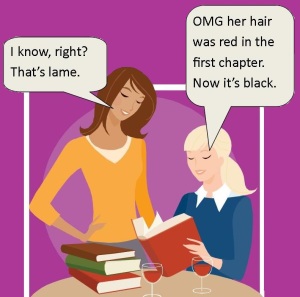
#3. Create a book bible for tracking all the details of your story. You can probably find a template for this if you google it. It’s important to make sure all of your details are consistent throughout the series so people don’t end up saying this about your novels:


#4. When recapping a previous book at the beginning of a sequel (which is always a good idea) don’t give everything about the last book away. You want readers that are starting in the middle of the series to want to be intrigued enough to go back. Always leave them wanting more.

"Ooh! What's that over there in book one?"

#5. This was a tough one for me to hear because I’m totally guilty of this: don’t save all the good stuff for your next book. This might sound like an obvious tip, but stop and think about it. Have you ever said when describing your series something like ‘Oh, well the bad guy’s identity isn’t revealed until book two.” Or how about, “Wait until you get to book three. That’s when the ultimate showdown happens.” If so, then you’re as guilty of this as I am. We have to give our first book everything we’ve got and not hold anything back. When it comes time to write the second book, we’ll come up with something even more epic to include. A writer’s imagination is endless. Remember: you’re not guaranteed to have your entire series published. Wouldn’t you hate for your readers not to get to read your ultimate fight scene just because you had planned it for a book that will never be published? I know. It burns. That’s how I felt when I first heard this tip. Put on some aloe and get back to writing.


#6. And my favorite series tip: Create ‘yes’ moments. Have you ever watched a show or read a series where something seemingly insignificant from the very beginning suddenly popped up much later in the series and became a vital part? That’s a ‘yes’ moment! It’s when those seeds you planted much earlier, have now popped up and blossomed into a full tree when you weren’t looking. If done correctly, it’s a very neat trick.